Yeti
The Legend of William OhYeti are large, intelligent predators associated with a hidden spawning ground beneath an icy mountain. Their defining danger is not merely physical strength: they resemble the hoarfrost covering the cave so closely that a hunter can stand among them without realizing the surrounding ice is alive. This camouflage allows them to turn an apparently empty landscape into a coordinated ambush, while their corpses provide valuable equipment and enough loot to transform a dangerous expedition into a profitable enterprise.
Habitat and Physical Concealment
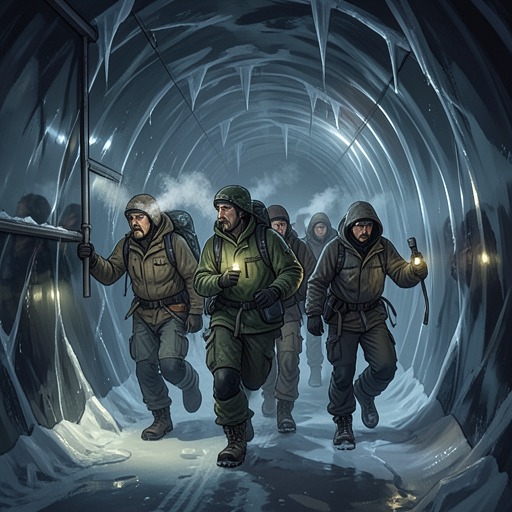
The Yeti spawning ground lies several switchbacks down a mountain trail, where the path turns inward toward a vast entrance to an extensive network of ice caves. The underside of the mountain receives no warmth from the sun; as clouds pass beneath the ranges, ice accumulates faster than it sublimates, producing a solid frozen layer. Repeated partial melting has left the cave floor deceptively smooth, forming a flat sheet of ice beneath an immense darkness.
The cave’s cold is severe enough that Steve Holland shivers despite the cold-weather gear he brought with him. William Oh’s glowbugs reveal an apparently endless expanse of ice and darkness, including a low lump partly covered in hoarfrost. What initially appears to be a harmless patch of frost is actually a Yeti concealed against the wall. Yeti fur and hoarfrost are nearly indistinguishable, and William Oh discovers that he has been surrounded before the first attack becomes visible.
Ambush Behavior and Intelligence
A concealed Yeti lashes out with clawed hands almost as large as William Oh’s torso. Its red face opens to reveal massive canines, and its roar awakens other ice-colored forms on the walls. The creatures surround William Oh from both directions, with a wall of fur and claws blocking the route back to the entrance. The arrangement suggests more than a spontaneous attack: the Yeti may have known he was present and used an abandoned boot as bait.
The Yeti also demonstrate basic tactical intelligence by arranging ambushes around nearly every piece of expensive equipment left by the previous expedition. Their method is effective because the equipment attracts intruders into predictable positions, but it is not inexhaustible. Once William Oh and Loth recognize the pattern, the threat becomes manageable through disciplined repetition: they trap one location, push farther into the caves, clear it, establish another trap, and continue forward while making sure their retreat remains protected against pursuit.
This change in the hunters’ understanding is crucial. The Yeti begin as an unseen presence embedded in the environment, converting the cave itself into a hostile disguise. After their pattern is exposed, they remain dangerous but lose the full advantage of surprise. The expedition therefore becomes a contest between the Yeti’s concealment and the Party’s ability to impose a counter-pattern on the tunnels.
The Hunting Expedition
Steve Holland presents the spawning ground as an opportunity capable of yielding fifteen thousand gold. He explains that an earlier Party of roughly half a dozen heavily equipped newcomers entered the area but were killed after bickering, fraternizing, and treating him as a porter and chef instead of taking the Tower seriously. In his assessment, William Oh and Loth would fare better because they would not need to divide the site’s rewards with other hunters.
William Oh’s response recognizes the irony of the proposal: he and Loth are also newcomers, despite being better prepared than the failed Party. They enter the cavern with Steve Holland, and William Oh tests the space by throwing Loth’s glowbugs beyond the entrance’s dim illumination. The lights expose the breadth of the frozen darkness without revealing the concealed predators. When William Oh approaches a frost-covered lump and wipes away its growing crystals, the Yeti’s camouflage is finally triggered into violence.
The Party survives by converting the creatures’ predictability into a method of advance. Loth’s careful positioning and protective work allow the others to trap, clear, and catalog the area rather than simply flee. The sequence culminates in what the narrative describes as a veritable Yeti buffet, followed by the System’s confirmation that William Oh has reached level 9 as a Resourceful Climber. The slaughter is therefore both a survival victory and a measurable advancement within the Tower’s progression system.
Remains, Loot, and Material Consequences
Yeti corpses caught in snares slowly decompose into pale-blue Miasma. As individual bodies evaporate, their equipment drops onto the ice, sometimes in a chain of successive clanks that draws the Party’s attention. The resulting haul includes ice cleats, a cloak, a war hammer made from a Yeti tusk, a nonmagical sword, an ice sickle, Boots of Grounding, a frost-covered helmet whose layer regrows whenever it is removed, a wicked-looking dagger, rings granting flat stat increases, and a Ring of Fire Resistance.
The expedition’s rewards are distributed according to practical need. The cloak offers better resistance to heat and cold than ordinary roc down, so Loth takes it. Steve Holland receives the cleats and becomes substantially more effective in the caves because he can finally run across the slippery floor. The tusk hammer is light despite its intimidating appearance, weighing only a few pounds, yet it feels solid and useful in William Oh’s hand. The Yeti thus function as more than obstacles: their bodies connect environmental danger to the Tower’s economy, equipment system, and advancement structure.
Narrative Significance
The Yeti episode makes concealment itself the central monster. The cave is not dangerous because every surface is visibly occupied; it is dangerous because the distinction between landscape and predator has collapsed. A patch of hoarfrost can be terrain, camouflage, bait, or the edge of a living formation, and the hunters cannot safely rely on first impressions.
Their intelligence also prevents the Yeti from functioning as simple disposable enemies. They learn where valuable gear will draw intruders, coordinate attacks from behind and ahead, and force the Party to account for its own trail. Yet their intelligence remains bounded by recognizable habits. Once William Oh and Loth identify the ambush cycle, they can answer it with traps and controlled forward movement. The encounter therefore establishes a recurring Tower principle: survival depends less on overpowering every threat than on discovering the mechanism by which that threat acts, then turning the mechanism against it.